
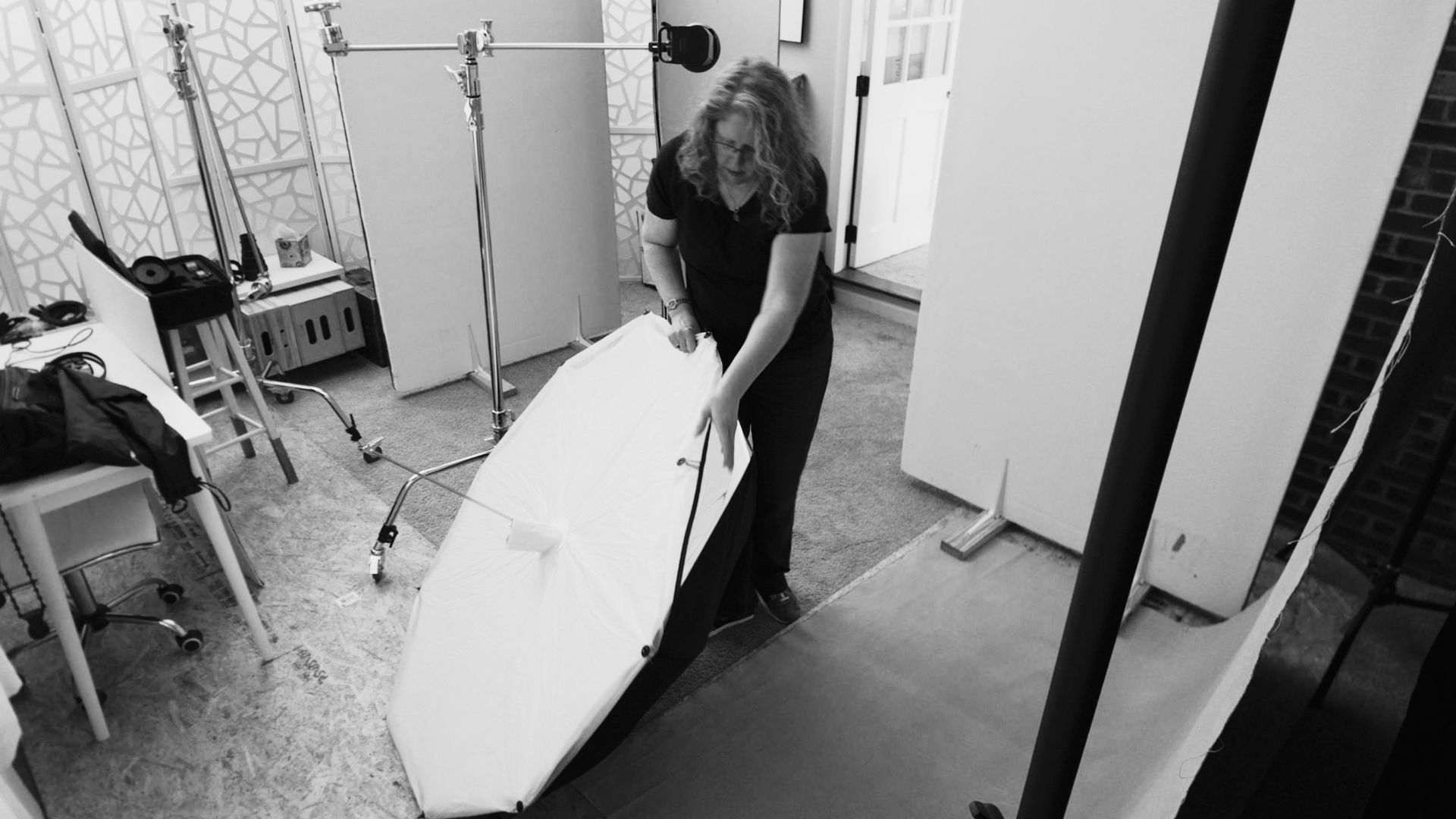
Jennifer assembles a modifier for a portrait interview at Redhead Creative Media’s studio in Chapel Hill, NC.
Tell me if this has ever happened to you:
You book something that’s genuinely exciting for you. And then, almost immediately, a different voice shows up. It’s the one that says you’re not worth it, or that you’ve made the wrong choice.
That’s imposter syndrome. And it hits hardest when there’s nothing external to justify the decision.
If what you’ve booked is for your kids, your team, or your family, there’s a built-in reason.
But if it’s just for you? That’s when the voice gets loud.
Before we go any further: I want to be clear that you have value, and you are worth it.
Your Story Doesn’t Need Permission
What I’ve learned is that it doesn’t matter what the doctor told you. It doesn’t matter what the therapist told you.
Your lived experience is valid on its own terms.
I’ve interviewed World War Two survivors. I’ve interviewed musicians. I’ve interviewed parents at PTA meetings.
Every single one of them has taught me the same thing: that their story mattered, and their viewpoint mattered, regardless of who did or didn’t confirm it for them.
So when that imposter syndrome pops up, the answer isn’t to wait for permission. It’s to say: no, I do have value. I do have worth.
I Feel It Too
I’m not saying this from the outside looking in.
When I got my first job out of graduate school, I remember sitting there thinking I wasn’t doing enough to earn my paycheck, even though the work hadn’t ramped up yet. It felt unearned, even though it wasn’t.
And it still shows up. Almost every single session, some version of that voice asks: am I really going to be able to create what they’re asking for?
I work through it every time. That’s not a sign something’s wrong. It’s just what happens whenever you’re doing something that matters to you.
That voice you hear when you’re booking a session – maybe you’re not worth it, maybe you shouldn’t spend that much, maybe you don’t need all of those pictures of yourself – it isn’t the truth. It’s an internal mechanism trying to keep you safe. That’s all.
What Actually Happens in the Room
One thing I can promise: I work hard to make the studio a safe space. Somewhere you can relax into creating imagery you’ll genuinely love: something to hang on your wall, put in an album, or simply keep for yourself. It’s entirely up to what your goal is. There’s no wrong answer.
But the session itself is a partnership.
I bring the expertise, the studio, the lighting, the tools of the profession. You bring the story.
During our design consultation, we pick out a specific chapter of your life, that thread I’m going to interview you about. The emotions, the descriptors, everything that makes that chapter yours. I use that information to build studio setups tied directly to those emotions.
Because you’re the one in control of the story being told. I’m just here to help you tell it well.
What I Wish I’d Asked
I come back to this a lot: there’s so much I wish I’d known about my mom, my grandparents, my aunt, my uncle. Things I never asked, because I assumed there’d be time. “They’ll be there,” I would always think. “I can ask later.”
But we don’t actually have unlimited time together in this space.
And when you choose to tell your story, not because someone asked you to, but because you want to honor who you are, where you’ve been, what you’ve done, that’s when the imposter syndrome finally has nowhere left to hide.
Tell It To Take a Hike
Whether you’re building a legacy for your family or documenting your expertise for your business, the story is the most important part.
We can figure out the right way to honor it. Visual portraiture, documentary footage, whatever fits the goal you have in mind.
If this resonated with you, if you’re ready to rethink what your lived experience is worth and finally document it, book a curiosity call below.
Let’s get the conversation started.